




What You Need to Know About the Supreme Court and the Upcoming Assault Weapons Ban Case
The Supreme Court will hear oral argument about assault weapons ban challenges on December 2, 2026. Here’s what you need to know about what is at stake in one of this term’s most pressing cases.
What is the assault weapons ban case before the Supreme Court?
On December 2, 2026, the U.S. Supreme Court will hear oral argument in two consolidated cases: Viramontes v. Cook County and Grant v. Higgins. Viramontes concerns a county-level restriction in Cook County, Illinois. Grant is a challenge to a Connecticut state law.
Both Viramontes and Grant involve reckless gun lobby challenges to laws restricting assault weapons.
What is the big question in this case?
The big question the Supreme Court will be considering is: Does the U.S. Constitution guarantee the right to possess assault weapons, like AR-15s? Under its text, history, and tradition framework, the Court will ask whether laws prohibiting these weapons are consistent with our nation’s historical tradition of firearms regulation.
The cases before the Supreme Court deal specifically with laws prohibiting assault weapons, as defined in the Cook County and Connecticut statutes. However, the Supreme Court’s decision will have implications for state and local assault weapons bans across the country.
Remind me: What are assault weapons?
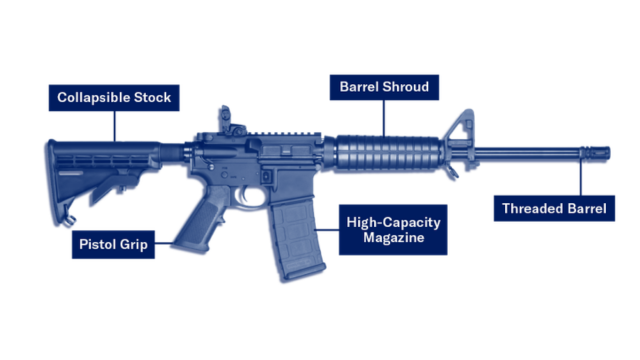
Assault weapons are semiautomatic rifles, shotguns, and pistols that work with large-capacity magazines and have certain military-style features that increase their lethality. The Supreme Court case is about rifles specifically. Assault weapons are:
- Exceptionally deadly
- Specifically designed to load and fire more bullets more quickly, taking more lives and causing more traumatic injuries
- The weapon of choice for mass shooters
Why did this assault weapons ban case go to the Supreme Court?
At present, 16 states and Washington, D.C., regulate assault weapons. Eleven of those states and D.C. have banned them. But the gun lobby has challenged these laws all across the country.
Assault Weapons Prohibited
11 states have adopted this policy
Assault Weapons Prohibited
Alabama has not adopted this policy
Assault Weapons Prohibited
Alaska has not adopted this policy
Assault Weapons Prohibited
Arizona has not adopted this policy
Assault Weapons Prohibited
Arkansas has not adopted this policy
Assault Weapons Prohibited
California has adopted this policy
Assault Weapons Prohibited
Colorado has not adopted this policy
Assault Weapons Prohibited
Connecticut has adopted this policy
Assault Weapons Prohibited
Delaware has adopted this policy
Assault Weapons Prohibited
Florida has not adopted this policy
Assault Weapons Prohibited
Georgia has not adopted this policy
Assault Weapons Prohibited
Hawaii has not adopted this policy
Assault Weapons Prohibited
Idaho has not adopted this policy
Assault Weapons Prohibited
Illinois has adopted this policy
Assault Weapons Prohibited
Indiana has not adopted this policy
Assault Weapons Prohibited
Iowa has not adopted this policy
Assault Weapons Prohibited
Kansas has not adopted this policy
Assault Weapons Prohibited
Kentucky has not adopted this policy
Assault Weapons Prohibited
Louisiana has not adopted this policy
Assault Weapons Prohibited
Maine has not adopted this policy
Assault Weapons Prohibited
Maryland has adopted this policy
Assault Weapons Prohibited
Massachusetts has adopted this policy
Assault Weapons Prohibited
Michigan has not adopted this policy
Assault Weapons Prohibited
Minnesota has not adopted this policy
Assault Weapons Prohibited
Mississippi has not adopted this policy
Assault Weapons Prohibited
Missouri has not adopted this policy
Assault Weapons Prohibited
Montana has not adopted this policy
Assault Weapons Prohibited
Nebraska has not adopted this policy
Assault Weapons Prohibited
Nevada has not adopted this policy
Assault Weapons Prohibited
New Hampshire has not adopted this policy
Assault Weapons Prohibited
New Jersey has adopted this policy
Assault Weapons Prohibited
New Mexico has not adopted this policy
Assault Weapons Prohibited
New York has adopted this policy
Assault Weapons Prohibited
North Carolina has not adopted this policy
Assault Weapons Prohibited
North Dakota has not adopted this policy
Assault Weapons Prohibited
Ohio has not adopted this policy
Assault Weapons Prohibited
Oklahoma has not adopted this policy
Assault Weapons Prohibited
Oregon has not adopted this policy
Assault Weapons Prohibited
Pennsylvania has not adopted this policy
Assault Weapons Prohibited
Rhode Island has adopted this policy
Assault Weapons Prohibited
South Carolina has not adopted this policy
Assault Weapons Prohibited
South Dakota has not adopted this policy
Assault Weapons Prohibited
Tennessee has not adopted this policy
Assault Weapons Prohibited
Texas has not adopted this policy
Assault Weapons Prohibited
Utah has not adopted this policy
Assault Weapons Prohibited
Vermont has not adopted this policy
Assault Weapons Prohibited
Virginia has adopted this policy
Assault Weapons Prohibited
Washington has adopted this policy
Assault Weapons Prohibited
West Virginia has not adopted this policy
Assault Weapons Prohibited
Wisconsin has not adopted this policy
Assault Weapons Prohibited
Wyoming has not adopted this policy
Data from 2026
Six federal appeals courts across the country have upheld bans on assault weapons and/or large-capacity magazines. Only one has ruled to the contrary — and that court then put its ruling on hold pending Supreme Court review.
So why has the gun lobby repeatedly sued state and local governments to force assault weapons back onto our streets? Because the gun industry stands to profit. These weapons of war are endlessly customizable and extraordinarily profitable. Research has found that gun sales spike in the months immediately after the deadliest mass shootings,1Rachael A. Callcut et al., “Effect of Mass Shootings on Gun Sales—A 20-Year Perspective,” Journal of Trauma and Acute Care Surgery 87, no. 3 (2019): 531–40, https://doi.org/10.1097/TA.0000000000002399. driven by fear of regulation. And a Washington Post analysis found that at least two-thirds of the assault weapons in circulation by 2020 were made and sold after the mass shooting at Sandy Hook Elementary School in 2012.2Todd C. Frankel et al., “The Gun That Divides a Nation,” Washington Post, March 27, 2023, https://www.washingtonpost.com/nation/interactive/2023/ar-15-america-gun-culture-politics/.
“A single person with a single weapon can kill 9 people and wound 17 in the space of 32 seconds. That just wasn’t possible at the Founding or Reconstruction.”
— Janet Carter, Managing Director of Second Amendment Litigation, Everytown Law
What is at stake in this case?
The Supreme Court has a choice. It can allow more people to arm themselves with devastatingly lethal weapons. Or, it could let state and local governments save lives by restricting deadly weapons of war.
4x
In mass shootings, four times as many people are shot when an assault weapon or high-capacity magazine is involved compared with incidents involving neither.
Everytown Research analysis of mass shootings in the United States, 2016–2025. A mass shooting is defined as any incident in which four or more people were shot and killed in a single incident. Tannuja D. Rozario and Paige Tetens, “Assault Weapons and High-Capacity Magazines,” Everytown for Gun Safety Support Fund, June 24, 2026, https://everytownresearch.org/report/assault-weapons-and-high-capacity-magazines/.
Last updated: 6.24.2026
Every single one of the ten highest-casualty mass shootings in America between 2016 and 2025 involved both an assault weapon and a large-capacity magazine. Bullets shot from the most common assault weapons can penetrate interior walls, car doors, and bulletproof vests commonly worn by police.
Assault rifles like AR-15s and AK-47s were originally designed for military use. They gave soldiers maximum firepower to overwhelm enemies on the battlefield. Then the gun industry saw a chance to profit and began selling semiautomatic versions of these dangerous weapons to civilians.
Armed with an assault weapon, a shooter can fire dozens of shots in seconds with greater control, maneuverability, and speed than traditional firearms. And that puts our children, communities, and first responders at extreme risk.
In the 2019 Dayton mass shooting, police officers heroically stopped the shooter in just 32 seconds. In those 32 seconds, armed with an AR-15-style assault weapon, the shooter fired 41 rounds, killing nine people and wounding 17 others.
Assault weapons are not just used in mass shootings: Police recoveries of assault weapons in major U.S. cities jumped by 27% from 2020 to 2024. Those recoveries signal a dangerous rise of warzone firepower in local communities. But it doesn’t have to be this way.
Do assault weapons bans even work?
Yes, bans on assault weapons and large-capacity magazines are effective at preventing mass shootings and the casualties associated with them. Research shows that counties in states with assault weapons bans experience a 41 percent lower incidence of mass shooting fatalities.
In 1994, Congress passed the federal assault weapons ban. The law restricted the manufacture, transfer, or possession of certain assault weapons and large-capacity magazines. The law was in effect from September 1994 to September 2004. Research suggests that keeping the federal assault weapons ban in place from 2005 through 2022 could have prevented an estimated 38 public mass shootings.
In the absence of a federal ban, these weapons of war remain accessible across too much of the nation. But drawing a firm line against weapons of war in our communities has widespread public support and is entirely constitutional. The law, the research, and the American people are on our side. And this case offers a chance for the Supreme Court to put public safety over gun lobby profits and keep battlefield power off our streets.
How could the Supreme Court’s decision affect existing laws about assault weapons?
The Supreme Court has a choice to make: Keep these weapons of war out of our communities, or make it easier for the next mass shooter to get their hands on deadly firepower.
If the laws at stake in this case are struck down, there will be immediate consequences for Connecticut and Cook County’s laws. Depending on the wording of the decision, other local- and state-level laws prohibiting assault weapons would also be in jeopardy. If the Supreme Court rules that assault-weapons bans are unconstitutional, no government at the local, state, or federal level will be able to enact these bans.
When will the justices rule on the assault weapons ban case?
The Supreme Court will rule on the consolidated Viramontes and Grant case by mid-2027.
Will the Supreme Court uphold assault weapons bans?
We don’t know how the Supreme Court will rule. We do know that:
- Its decision to review an assault weapons ban case does not mean it will strike down these bans; and
- The constitutional arguments in favor of upholding these laws are very strong.
Now that the case has been granted, even congressional Republicans do not want to get behind the gun lobby on this issue. The number of Republicans willing to sign an amicus brief supporting the challengers has cratered compared to past major Second Amendment cases:
- Senate Retreat: 25 Republican U.S. senators signed an amicus brief supporting the Second Amendment challenge in NYSRPA v. Bruen. In Viramontes, that support plummeted to just five senators.
- House Drop-Off: Support dropped from 83% of House Republicans for Bruen down to under 30% for Viramontes. Crucially, key members of House leadership who signed on for Bruen, including Speaker Johnson and Majority Leader Scalise, declined to join the amicus brief this time around.
Ultimately, the Court is choosing between allowing local communities to save lives or allowing the gun industry to profit by making it easier for mass killers to get their hands on devastating weapons of war. The Supreme Court must uphold these laws. And we will fight with everything we have to remind the Court and nation of what is at stake. Rally with us at the Supreme Court on Wednesday, December 2, 2026, to help keep these weapons of war out of our communities.
The Latest

The Supreme Court Ruled Against Hawai‘i’s No-Carry Default Rule in Wolford v. Lopez. Here’s What You Need To Know.

What to Know About Wolford v. Lopez
How do guns enter the illegal market?
According to ATF research, the three leading methods of gun trafficking are straw purchasing, unlicensed dealing, and thefts from gun dealers.