


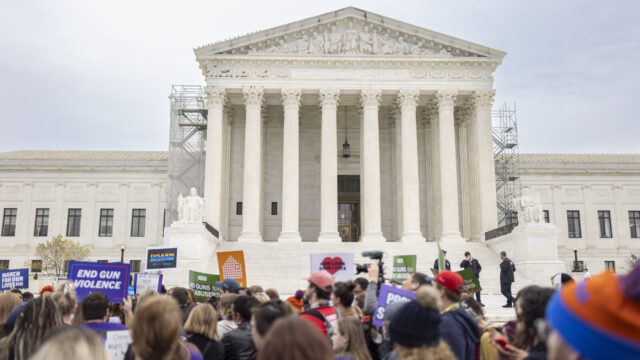
The U.S. Supreme Court heard oral argument in the Wolford v. Lopez case on January 20, 2026. Here’s what you need to know.
What’s the question in this case?
The question in Wolford v. Lopez is this: Can a state prohibit carrying firearms on others’ private property open to the public without permission?
Put another way: Until property owners have stated their preference, should the law assume they want guns on their property, or should it assume they don’t? Hawai‘i’s law respects property owners by making “no guns” the default rule, until stated otherwise. The Supreme Court in Wolford will decide if that law is constitutional.
Who are the parties involved in this case?
There are four plaintiffs and one defendant in Wolford v. Lopez.
The plaintiffs challenging Hawai‘i’s law are three Maui residents (Jason Wolford, Alison Wolford, and Atom Kasprzycki) and a gun-rights organization, the Hawaii Firearms Coalition.
Hawai‘i Attorney General Anne E. Lopez is the defendant. Former Acting U.S. Solicitor General Neal Katyal is representing the Hawai‘i Attorney General and will be arguing the case in the Supreme Court.
What is the Hawai‘i law at issue?
After the Supreme Court’s 2022 decision in New York State Rifle & Pistol Ass’n v. Bruen, Hawai‘i passed a law setting a common-sense default for gun owners, which prohibits firearms on private property open to the public without the owner’s permission. So, until a property owner posts a sign allowing guns or says “yes, feel free to carry on my land,” the answer is “no.” This law ensures that public safety and property rights remain protected.
What is Hawai‘i’s “no-carry” default rule?
A private property owner can always decide to prohibit guns on their property. There is no right to carry guns onto private property against the wishes of the private property owner—an argument both sides agree with in this case. Under Hawai‘i’s law, gun owners may not carry guns on private property unless they are given permission to do so (through a sign, conversation, or other verbal or written notice).
This “no-carry” default simply codifies what most Americans already believe: You don’t walk into someone else’s home or business with a weapon unless you know you’re welcome to do so. This is a common-sense safety measure that prevents confusion and potentially dangerous confrontations.
The law leaves the ultimate decision in the hands of the property owner. If a shopkeeper wants to allow guns in their store, for example, they are perfectly free to do so.
Why did this case go to the Supreme Court?
Gun rights litigants challenged the law, and with the case still at a preliminary stage, the Ninth Circuit Court of Appeals issued a ruling in September 2024 correctly upholding it. The Ninth Circuit concluded that it is fully constitutional to set a default that requires consent before carrying a firearm on someone else’s land.
The Supreme Court agreed to review this issue in Wolford v. Lopez and heard oral argument on Tuesday, January 20, 2026.
What’s at stake in this decision?
If the Supreme Court strikes down Hawai‘i’s law in Wolford v. Lopez, it would effectively impose a national mandate that guns are allowed into private businesses open to the public by default, stripping all 50 states of the power to protect the autonomy of property owners.
A ruling for Hawai’i, on the other hand, would be a ruling for local choice. It would allow states to listen to their constituents and set the default rules that work best for their specific communities. Hawai‘i residents may want one rule, while Floridians may want another—that would remain up to them. Research shows a majority of Americans across the political spectrum prefer this “no-carry” default.
We won’t know what approach the Court will take—and what that will mean for Hawai‘i’s law—until after it issues its decision later this year.
Join our mailing list to be among the first to know about the Supreme Court’s decision in Wolford v. Lopez.
The Latest
How do guns enter the illegal market?
According to ATF research, the three leading methods of gun trafficking are straw purchasing, unlicensed dealing, and thefts from gun dealers.1…
How the Saving Our Veterans Lives Act Could Help End the Crisis of Veteran Firearm Suicide
Congress Is Trying to Pass a Dangerous Federal Concealed Carry Mandate. Here’s How We Can Stop It.