


Congress Is Trying to Pass a Dangerous Federal Concealed Carry Mandate. Here’s How We Can Stop It.
Key Takeaways
- Lawmakers in Congress are proposing a dangerous bill that would create a federal concealed carry mandate, also known as concealed carry reciprocity (H.R. 38 and S. 65).
- Passing what it calls “concealed carry reciprocity” is one of the gun industry’s top priorities.
- This legislation would:
- Force each state to allow people from other states to carry hidden, loaded guns in public, even in states that wouldn’t otherwise let them
- Make it more difficult for police officers in one state to enforce their state and local gun safety laws against people from other states
- Override common-sense state gun laws that help protect communities from gun violence
- In states that repealed strong permit requirements for carrying a concealed gun in public, gun assaults increased by 32%.
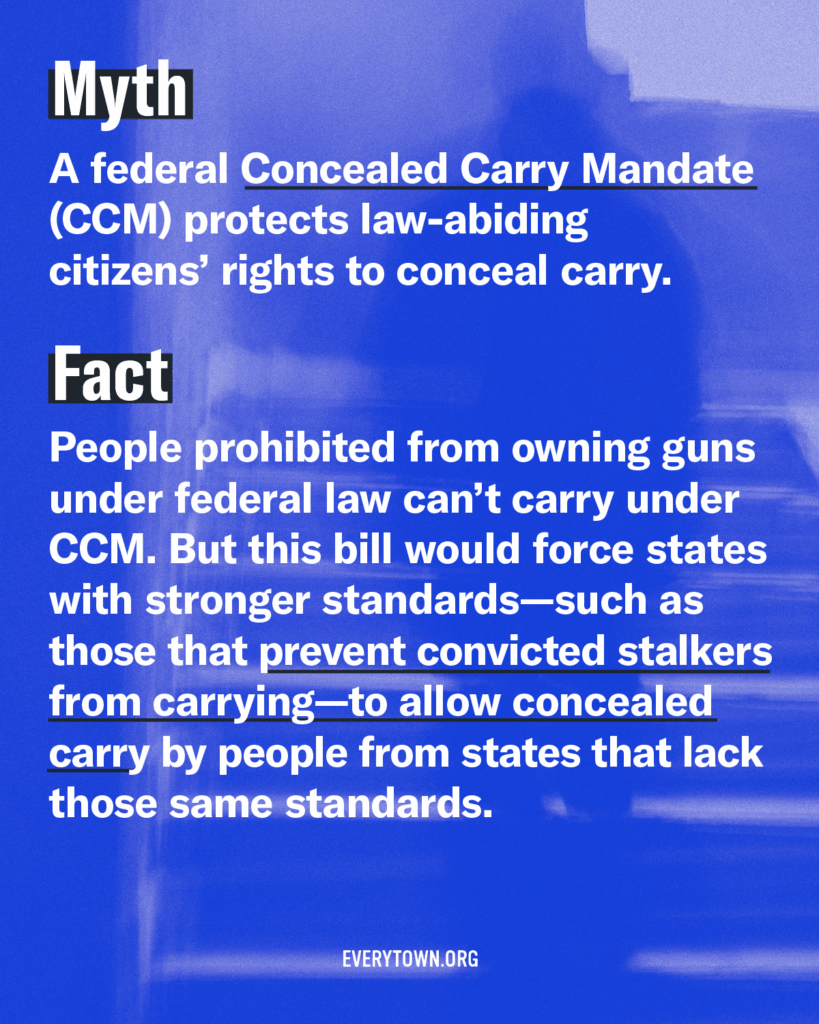
A federal concealed carry mandate, sometimes called “concealed carry reciprocity,” is proposed legislation that would force each state to allow people from all other states to carry a hidden, loaded gun in public—even in states that wouldn’t otherwise let them. The Concealed Carry Mandate guts our gun laws and tramples on states’ rights, putting everyone at risk.
What is the Constitutional Concealed Carry Reciprocity Act of 2025?
In all 50 states, people are allowed to carry hidden, loaded guns in public, and states have long had the power to make their own decisions about who can and cannot do so. Additionally, every state can also choose which out-of-state carriers, if any, to carry a concealed firearm within its own state borders.
Currently, states have different requirements and standards for who can carry a concealed gun in public. Some states require permits, while others do not. Some states have standards that block certain categories of people from concealed carrying, like:
- Those who have been convicted of violent misdemeanor crimes,
- Abusive dating partners (beyond those prohibited under federal law), and
- Individuals under the age of 21.
The Constitutional Concealed Carry Reciprocity Act of 2025 (H.R. 38 and S. 65) is proposed legislation that would create a federal concealed carry mandate. That mandate would require each state to recognize every other state’s concealed carry requirements and standards, even from states that don’t require a permit to carry—or have no standards at all.
Myth
“The Second Amendment does not disappear when crossing an invisible state line.”
Fact
The Second Amendment does not stop at the state line, but that doesn’t mean that states can’t set their own reasonable conditions on who can carry a concealed and loaded gun in public within their own borders. The Concealed Carry Mandate, however, would override these conditions, mandating that each state allow concealed carriers from all other states—putting more guns in more hands in more public places. In fact, the Supreme Court has consistently clarified1While the Supreme Court in New York State Rifle & Pistol Association, Inc. v. Bruen struck down the century-old proper cause requirement in New York’s permit law in 2022, the Supreme Court left in place the rest of New York’s permit law and similar laws in all other states requiring a permit to carry. In other words, it remains constitutional to require a permit to carry a concealed and loaded gun in public, and to require that someone seeking a permit to meet the standards set forth in their state’s law. Justice Kavanaugh’s concurrence in Bruen, which Chief Justice Roberts joined, further explains this. He wrote that Bruen “does not prohibit States from imposing licensing requirements for carrying a handgun for self-defense.” that reasonable conditions are constitutional.
What would a federal concealed carry mandate look like?
Our country doesn’t look the same everywhere you go. We have crowded cities, small towns, farm communities, and everything in between. That’s why states have long had the power to decide for themselves who can carry a hidden, loaded gun in public and where.
A federal concealed carry mandate would erase that.
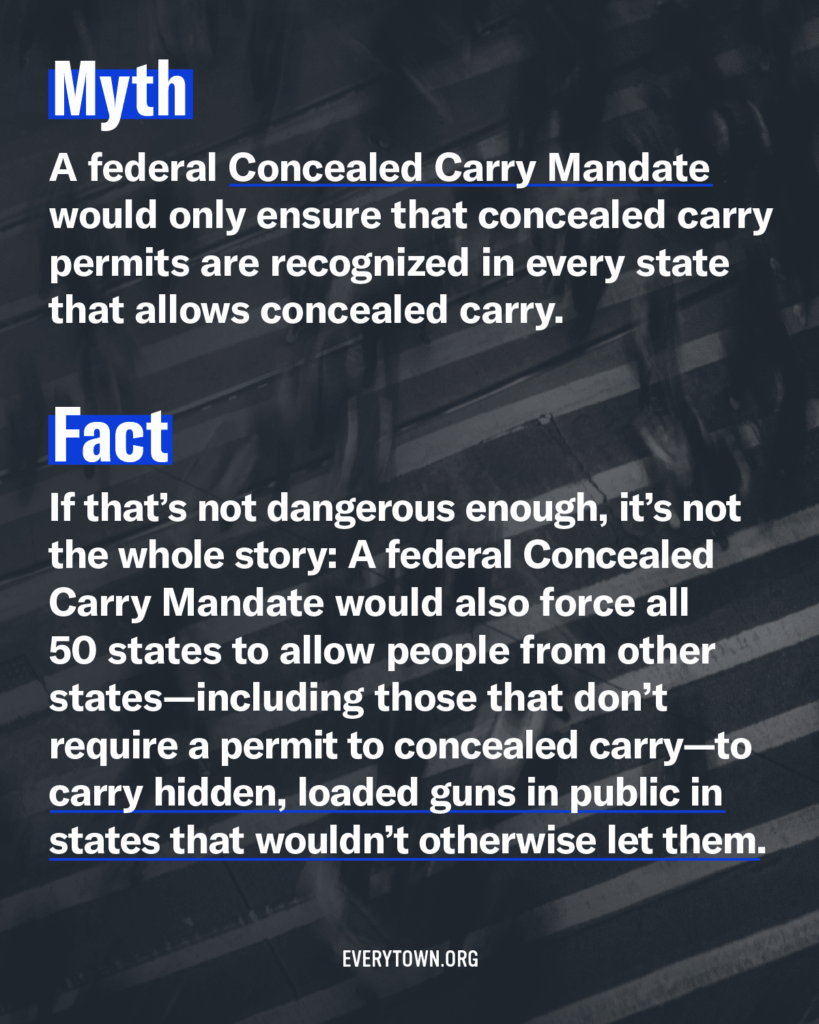
This extremist mandate would force each state to allow individuals from other states to carry a hidden, loaded gun in public places—even in states that wouldn’t otherwise allow them to. This includes people from states that do not require a permit and from states that have few, if any, concealed carry standards in place. That means that many people could do so:
- Without passing a background check
- Without any safety training
- Without ever handling a firearm before
This also means people with dangerous histories, like violent criminals, domestic abusers (beyond those prohibited under federal law), and convicted stalkers, would be able to carry a concealed gun in states that wouldn’t otherwise let them.
3 in 4
Three in four Americans oppose allowing people to carry concealed guns without a permit, including a majority of gun owners and Republicans.
Pew Research Center, “Gun Violence Widely Viewed as a Major—and Growing—National Problem,” June 28, 2023, https://www.pewresearch.org/wp-content/uploads/sites/20/2023/06/PP_2023.06.28_gun-violence_REPORT.pdf.
32%
States that abandoned strong concealed carry permitting systems—including those with live firearm training requirements—for permitless carry from 1981 to 2019 saw an average 32 percent increase in gun assaults.
Mitchell Doucette et al., “Deregulation of Public Civilian Gun Carrying and Violent Crimes: A Longitudinal Analysis 1981-2019,” Criminology & Public Policy 23 (2024): 833–61, https://doi.org/10.1111/1745-9133.12638.
How would a federal concealed carry mandate change anything?
Right now, 29 states allow some form of permitless carry. However, the remaining states still require permits to carry a hidden, loaded gun in public, and the requirements for these permits differ widely.
Concealed Carry Permit Required
21 states have adopted this policy
Alabama has not adopted this policy
Alaska has not adopted this policy
Arizona has not adopted this policy
Arkansas has not adopted this policy
California has adopted this policy
- If so, does the state require training?
- Yes
- Does state training include firing an actual gun?
- Yes
Colorado has adopted this policy
- If so, does the state require training?
- Yes
- Does state training include firing an actual gun?
- Yes
Connecticut has adopted this policy
- If so, does the state require training?
- Yes
- Does state training include firing an actual gun?
- Yes
Delaware has adopted this policy
- If so, does the state require training?
- Yes
- Does state training include firing an actual gun?
- Yes
Florida has not adopted this policy
Georgia has not adopted this policy
Hawaii has adopted this policy
- If so, does the state require training?
- Yes
- Does state training include firing an actual gun?
- Yes
Idaho has not adopted this policy
Illinois has adopted this policy
- If so, does the state require training?
- Yes
- Does state training include firing an actual gun?
- Yes
Indiana has not adopted this policy
Iowa has not adopted this policy
Kansas has not adopted this policy
Kentucky has not adopted this policy
Louisiana has not adopted this policy
Maine has not adopted this policy
Maryland has adopted this policy
- If so, does the state require training?
- Yes
- Does state training include firing an actual gun?
- Yes
Massachusetts has adopted this policy
- If so, does the state require training?
- Yes
- Does state training include firing an actual gun?
- Yes
Michigan has adopted this policy
- If so, does the state require training?
- Yes
- Does state training include firing an actual gun?
- Yes
Minnesota has adopted this policy
- If so, does the state require training?
- Yes
- Does state training include firing an actual gun?
- Yes
Mississippi has not adopted this policy
Missouri has not adopted this policy
Montana has not adopted this policy
Nebraska has not adopted this policy
Nevada has adopted this policy
- If so, does the state require training?
- Yes
- Does state training include firing an actual gun?
- Yes
New Hampshire has not adopted this policy
New Jersey has adopted this policy
- If so, does the state require training?
- Yes
- Does state training include firing an actual gun?
- Yes
New Mexico has adopted this policy
- If so, does the state require training?
- Yes
- Does state training include firing an actual gun?
- Yes
New York has adopted this policy
- If so, does the state require training?
- Yes
- Does state training include firing an actual gun?
- Yes
North Carolina has adopted this policy
- If so, does the state require training?
- Yes
- Does state training include firing an actual gun?
- Yes
North Dakota has not adopted this policy
Ohio has not adopted this policy
Oklahoma has not adopted this policy
Oregon has adopted this policy
- If so, does the state require training?
- Yes
- Does state training include firing an actual gun?
- No
Pennsylvania has adopted this policy
- If so, does the state require training?
- No
- Does state training include firing an actual gun?
- —
Rhode Island has adopted this policy
- If so, does the state require training?
- Yes
- Does state training include firing an actual gun?
- Yes
South Carolina has not adopted this policy
South Dakota has not adopted this policy
Tennessee has not adopted this policy
Texas has not adopted this policy
Utah has not adopted this policy
Vermont has not adopted this policy
Virginia has adopted this policy
- If so, does the state require training?
- Yes
- Does state training include firing an actual gun?
- No
Washington has adopted this policy
- If so, does the state require training?
- Yes
- Does state training include firing an actual gun?
- Yes
West Virginia has not adopted this policy
Wisconsin has adopted this policy
- If so, does the state require training?
- Yes
- Does state training include firing an actual gun?
- No
Wyoming has not adopted this policy
Data from 2025
States have different requirements for who can carry a concealed and loaded gun in public—which is a huge responsibility. While some states require permits, there are others that do not.
To get a permit, a person must:
- Pass a background check and
- Meet other standards that are set out in state law, including standards that block certain people from carrying and standards that require people who want to carry to take certain steps.1Standards that may block certain categories of people from carrying include:
– Convicted of a Misdemeanor Violent Crime
– Convicted of Stalking
– Convicted of Multiple Recent DUIs
– Abusive Dating Partners (beyond the federal floor)
– Under 21
– Danger to Public
Safety Standards that require people who want to carry to:
– Complete Firearms Safety Training
– Have Live-Fire Shooting Experience
These are standards that help protect public safety and promote responsible gun ownership. States with stronger permitting requirements see less gun violence.
But a federal concealed carry mandate would force each state to let people from other states, including those that don’t require permits and those that lack standards, to carry a hidden, loaded gun in public in states that wouldn’t otherwise let them. It’s the gun industry’s dream and a nightmare for public safety.
It’s important to note that there is no nationwide system for verifying out-of-state carry permits. That’s a significant challenge for law enforcement when they encounter someone from out of state who is carrying a hidden, loaded gun in public. Police wouldn’t be able to quickly verify if someone has a valid permit or is even allowed to carry—and, under H.R. 38, could be sued for even trying.
These complexities jeopardize both public and officer safety. They also make it more difficult for police to enforce state and local gun safety laws. And if a person is from a permitless state, there’s even more uncertainty, as there’s no permit for law enforcement to check in the first place.
Defining terms: Permitless carry, concealed carry, and open carry
- Permitless carry: Laws that allow someone to carry a hidden, loaded gun in public with no permit and no training. Learn more about permitless carry.
- Concealed carry: Carrying a firearm in a way that is not visible to the public, such as under clothing or in a bag
- Open carry: Carrying a firearm that is visible to others in public. Open carry typically involves carrying a handgun in a holster or a long gun (like a rifle) slung over the shoulder.
How would a federal concealed carry mandate, aka concealed carry reciprocity, “override states’ rights”? That feels like a stretch.
Right now, every state has the right to choose the rules that its own residents must follow to carry a hidden, loaded gun in public within its own borders. And every state can also choose how and if it wants to allow out-of-state carriers to carry a concealed firearm within its own state borders.
States fall into three broad categories:
- No reciprocity: Many states do not recognize concealed carriers from other states—whether such people have been issued an out-of-state permit or not.
- Selective reciprocity: Other states have made determinations to allow out-of-state concealed carriers from some states and not others, often based on the strength of other states’ standards, and sometimes subject to certain conditions.
- Full reciprocity: Some states voluntarily recognize out-of-state permits and concealed carriers from permitless states.
I’m still having a hard time wrapping my head around what a Concealed Carry Mandate means. Can you give me an example?
You know when you’re driving and someone cuts you off, so you look at their license plate and see that they’re from another state? And you think, “Oh, yeah, that makes sense, people from that state drive so differently than I do?”
Well, imagine if that state didn’t require people to take driver’s ed or pass the test to get a driver’s license, even though your state still does. And imagine that there’s a federal law mandating that we still have to let people from these other states drive on our roads. (Even though—again—they don’t have to do the same thing we do to drive.)
That’s essentially what Congress is trying to do with H.R. 38 and S. 65, aka the House and Senate versions of the “Constitutional Concealed Carry Reciprocity Act of 2025.”
Myth
“Making states allow people from other states to carry hidden, loaded guns in public is essentially the same thing as making all 50 states accept each other’s driver’s licenses. After all, I can drive with my driver’s license anywhere in the U.S., even though my state might have differences in regulations or licensing requirements from another state.”
Fact
This is both inaccurate and misleading. To drive a car, you need a driver’s license. And to get a driver’s license, you need to be a certain age, complete drivers’ education, and pass a vision test, a written test, and a road test. These requirements are largely the same across all 50 states, which is why states voluntarily recognize each other’s driver’s licenses and allow out-of-state drivers to drive on their roads.
But right now, 29 states don’t require a permit to carry a hidden, loaded gun in public in the first place. (And because these states are permitless, there is no “driver’s license” equivalent.) To carry hidden, loaded guns in public in these states, the only thing a person must do is meet the minimal standards that a state has in place. None of those states requires safety training or shooting experience. And 10 of these states don’t have any substantial standards at all—meaning that just about anyone legally allowed to have a gun can concealed carry in them.
You wouldn’t want an out-of-state driver who doesn’t have a license driving on the roads in your state. And you wouldn’t want an out-of-stater who doesn’t have a permit carrying a hidden, loaded gun in public in your state either.

Strong concealed carry requirements help protect public safety and promote responsible gun ownership. For example, New York has some of the strongest gun laws in the country—like requiring gun owners to get a permit to carry a concealed gun in public, plus strict standards for who can get one. And as a result, New York City has a gun homicide rate four times lower than the average large U.S. city.
But if Congress’ Concealed Carry Mandate becomes law, New York would be forced to let people from other states carry a concealed gun in New York—whether or not that person meets New York’s standards.
Here’s what this mandate could mean in real life: Under the Concealed Carry Mandate, if a man from South Carolina with a history of domestic violence were going after his estranged girlfriend in New York City, police officers couldn’t stop him from carrying his loaded gun in public. That’s because South Carolina doesn’t block abusers from carrying concealed guns. In fact, under H.R. 38, New York police officers could even be sued for stopping him and asking questions.
-
Example: How a Concealed Carry Mandate Would Allow Untrained Teens to Carry Concealed Guns Across the Country
Sam is a sophomore in college in South Carolina. He just celebrated his 19th birthday. As a birthday present, his dad gifted him a handgun that his dad had gifted him when he turned 19. Sam, however, has never handled this weapon before—let alone any gun for that matter. In fact, Sam’s never had any kind of gun safety training at all.
Sam’s birthday happens to line up with his winter break from school and the College Football Playoff. There’s nothing that Sam loves more than college football—especially when his team is in the playoffs. Lucky for him, his team is in it.
Sam and his friends decide to celebrate his birthday and their college team’s postseason success with a cross-country road trip to the quarterfinal at the Rose Bowl in California.
Under Current Law: Sam leaves his new gun at home in South Carolina.
In South Carolina, Sam does not need a permit to carry a concealed and loaded gun in public. He doesn’t need to have any safety training or any live-fire shooting experience. He doesn’t even need to be 21. But these are all requirements for Californians—and Sam isn’t allowed to carry his gun in California under California law.
Under H.R. 38 and S. 65: Sam packs his gun for the road trip and brings it with him to California.
Before the game, Sam and his friends go to a tailgate where there’s excitement in the air and thousands of people around. Sam decides to carry his gun, but, because he’s unfamiliar with the laws in California regarding where concealed guns may be carried, Sam doesn’t realize that guns aren’t permitted there.
Sam’s friends also don’t realize that Sam is carrying and that his gun is loaded. When they lift him to do a keg stand to thank him for planning the trip of a lifetime, Sam’s gun falls to the ground, goes off, and strikes a child at the tailgate next to them.
H.R. 38 and S. 65 would turn this hypothetical into reality. Under current law, Sam wouldn’t think his state law applied nationwide—and he would not be armed in this fateful moment. That’s because California is one of 20 states that require concealed carriers to complete firearm safety training and one of 17 states that require live-fire shooting experience. In addition, 30 states, including California bar concealed carry by young people under 21 years old.
But, under H.R. 38 and S. 65, because Sam can carry in South Carolina, he can carry in any other state, even in those that require safety training and live-fire shooting experience, and require concealed carriers to be at least 21. These states would be forced to let untrained and underage individuals like Sam from states like South Carolina concealed carry within their borders.
Whose rights is Congress trying to protect? Not states’ rights to decide their laws or law enforcement’s ability to enforce them. And certainly not our right to exist in public without being shot.
Survivor Story: Jennifer Sharp
My entire life has been marked by domestic violence.
I grew up in what appeared to be your average American family: A charming father, a lovely mother, two brothers, and a station wagon. On the outside, we looked like we had everything, but on the inside, we were broken and bruised.
My father was physically, mentally, and sexually abusive, and after years of enduring his abuse, my mother courageously left him to start a new life with me and my brothers. But just two years later, she found herself back in a vicious cycle of domestic abuse with a new partner.
On March 28, 1990, my mother, Cindy, was shot and killed by my stepfather. She was the glue that held us together—and her murder ripped my family apart.
Devastatingly, this was just the beginning of my family’s domestic violence story. I grew up without a model for a healthy relationship, and soon found myself caught up in similar cycles of abuse. But out of those relationships came two wonderful gifts: my son, Ryan, and my daughter, Kaila.
Kaila, like me and my mother, struggled to make good choices in partners. She suffered through one violent relationship after another, resulting in several hospitalizations, a miscarriage, and an arson attempt.
In January 2017, Kaila was admitted to the ICU in a coma for a traumatic brain injury she’d suffered at the hands of an abusive boyfriend. The prognosis was dire. But against miraculous odds, she recovered, relearning how to walk, talk, read, write, and feed herself. After her remarkable recovery, Kaila moved back to New Mexico, started dating a new man, moved in with him, and got engaged.
But he was a chronic alcoholic, verbally abusive, and controlling. They argued constantly. I urged her to leave, but she felt trapped and hopeless. She was approved for a domestic violence housing program, but the wait list was over a year long.
On February 2, 2019, I received a call from Kaila’s phone: It was a police officer who told me that my daughter had been shot in the head during a domestic dispute, and Kaila’s heart stopped in the helicopter en route to the hospital.
A very large part of me died with her that day. I have a gaping hole in my life that will never be filled.
The police tried for months to build a homicide case against Kaila’s fiancé—but the case was dropped. As of today, he still walks free. Not only that—but he still has a license to carry a concealed weapon in New Mexico.
Our leaders failed to protect my mother. They failed to protect Kaila. The last thing we need is for Congress to gut our state gun laws and put more people at risk by weakening our concealed carry standards.
88%
88 percent of Americans think you should get a permit before carrying a concealed gun in public.
Ingham K. “New Survey Finds Strong Opposition to Concealed Carry without a Permit”. Strategies 360. (2015). https://images.template.net/wp-content/uploads/2016/04/22064925/PDF-Gun-Safety-Release-Memo-Template-Download.pdf.
Most Americans support concealed carry permitting systems that help ensure that only responsible gun owners can carry concealed, loaded guns in public. A federal concealed carry mandate forces extreme, unpopular permitless carry onto more Americans than ever before.
We’re up against a Congressional majority and an administration that wants nothing more than to line the gun industry’s pockets and protect their special interests. But we stopped this dangerous bill in its tracks during the last Trump Administration—and we can do it again.
Take action
It’s time to tell Congress to vote NO on the Concealed Carry Mandate.
The Latest

What to Know About Wolford v. Lopez
How do guns enter the illegal market?
According to ATF research, the three leading methods of gun trafficking are straw purchasing, unlicensed dealing, and thefts from gun dealers.1…
How the Saving Our Veterans Lives Act Could Help End the Crisis of Veteran Firearm Suicide